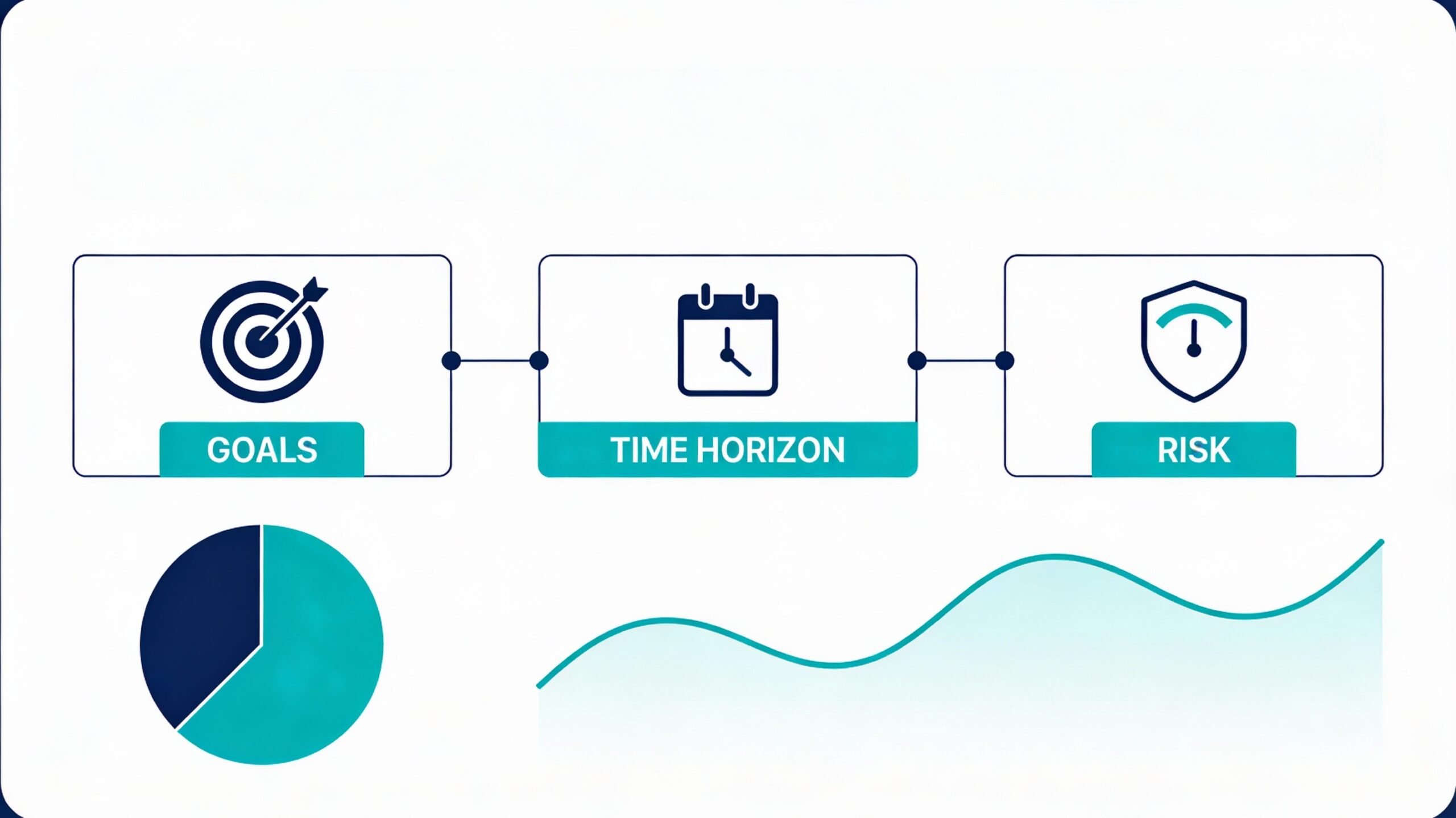
A portfolio should be built around your life, not the latest market trend. The simplest way to invest better is to align your money with three things: the goal you’re investing for, the time you have, and the amount of risk you can truly handle. When these three are in sync, decisions become calmer, more consistent, and easier to stick with.
1) Start with goals: give every investment a job
Before choosing any product, write down your goals and separate them into buckets:
-
Short-term goals: travel, gadgets, emergency buffer top-up.
-
Medium-term goals: home down payment, business setup, higher education plans.
-
Long-term goals: retirement, child’s education, legacy planning.
For each goal, define:
-
Target amount (approx.)
-
Target date (month/year)
-
Priority (must-have vs good-to-have)
This step prevents a very common mistake: using long-term assets for near-term needs.
2) Define your time horizon: it decides your risk budget
Time is the biggest driver of what you can invest in. A practical framework:
-
0–2 years: focus on liquidity and stability (protect capital).
-
3–5 years: balance growth and stability (avoid extreme volatility).
-
5–10+ years: you can usually take more growth exposure (you have recovery time).
If your goal date is close, even “good investments” can become bad choices because volatility has no time to normalize.
3) Understand risk the right way: capacity vs tolerance
Risk isn’t only about how brave you feel—it’s also about your financial situation.
-
Risk capacity: Your ability to take losses without harming your life (stable income, low EMI burden, good emergency fund = higher capacity).
-
Risk tolerance: Your emotional comfort when markets fall (how you react during drawdowns).
A portfolio that matches capacity but ignores tolerance often fails because the investor exits at the worst time. The best portfolio is the one you can hold through rough periods.
4) Build a goal-based asset allocation (not a “one-size” portfolio)
Instead of one portfolio for everything, create goal buckets:
-
Safety bucket (short-term): built for capital protection and quick access.
-
Stability bucket (medium-term): balanced approach to reduce big swings.
-
Growth bucket (long-term): aims for higher long-term returns and accepts volatility.
This structure keeps your near-term money away from high-volatility assets and gives long-term money the runway it needs.
5) Choose products last: simplify and stay consistent
After your allocation is clear, select instruments that fit each bucket. Use a simple checklist:
-
Does it match the goal timeline?
-
How liquid is it when you need to exit?
-
What are the costs and charges?
-
Is it diversified or concentrated?
-
Is the risk understandable?
If you can’t explain why you own something in one sentence, it’s probably not aligned.
6) Rebalance with rules (not emotions)
Over time, your allocation drifts—winners grow bigger, losers shrink. Rebalancing brings the portfolio back to the risk level you originally chose.
Two easy options:
-
Calendar rebalancing: review every 6 or 12 months.
-
Band rebalancing: rebalance when allocation drifts beyond a set range (example: ±5%).
This is how disciplined investors “buy low and sell high” without trying to time the market.
7) Track progress by goals, not daily returns
Daily returns create stress and impulsive decisions. Track:
-
Are you on track for each goal?
-
Is your savings/investment contribution consistent?
-
Is your risk level still suitable?
-
Has your income, liabilities, or timeline changed?
If the plan is on track, short-term volatility becomes easier to ignore.
Common mistakes to avoid
-
Mixing timelines: investing short-term goal money in volatile assets.
-
Chasing hot themes: buying what’s trending without a goal-based reason.
-
Ignoring liquidity: assuming exits will be easy when you need cash.
-
No review cycle: letting portfolio drift away from your risk profile.
-
Over-concentration: too much money in one stock/sector/idea.
A well-aligned portfolio is not built by predicting markets—it’s built by matching investments to goals, time horizon, and real-world risk comfort. If you want, share your target audience (beginner/HNI) and word count (600/1000/1500), and the blog can be rewritten in a sharper “Zelion Ventures” website tone with a conversion-focused CTA.